SAP Analytics Cloud Planning: The Complete Enterprise Guide
Part 2 — Data Strategy, Security, Performance, AI Future, and Enterprise Lessons Learned
📖 This is Part 2 of a two-part series. Read Part 1: Architecture, Planning Models & Integration Landscape →
6. Building the Right Data Strategy for SAC Planning
A successful SAC Planning implementation is fundamentally a data transformation initiative.
Many organizations approach SAC Planning as a finance application deployment:
“We need to configure planning screens and budgeting workflows.”
This mindset often leads to limited success.
The better approach is:
“We need to create a trusted enterprise planning ecosystem where business assumptions, operational drivers, and financial outcomes are connected.”
This requires a well-defined data strategy.
6.1 The Three Data Layers of Enterprise Planning
A scalable SAC Planning architecture typically separates data into three layers.
Layer 1: Operational Data
This is the transactional data generated by business systems.
Examples:
- SAP S/4HANA financial postings
- Sales orders
- Procurement transactions
- Production data
- HR workforce data
Purpose: Provide actual business performance.
Layer 2: Semantic Business Data Layer
This layer creates business meaning.
Typical technologies:
- SAP Datasphere
- SAP BW/4HANA
Responsibilities:
- Data harmonization
- Master data alignment
- Business rules
- Currency conversion
- Hierarchies
- Data quality
This layer answers:
“What does this data mean from a business perspective?”
Layer 3: Planning Layer
The SAC Planning model consumes business-ready information.
Responsibilities:
- Budget creation
- Forecasting
- Scenario simulation
- Allocations
- Planning workflows
- Management decisions
A mature architecture therefore looks like:
- Business Systems (Data Generation)
- Data Integration (Extraction & Harmonization)
- Semantic Enterprise Layer (Business Rules & Logic)
- SAC Planning Models (Budgeting & Simulation)
- Business Decisions (Actionable Outcomes)
6.2 Master Data Governance: The Foundation Most Projects Underestimate
One of the biggest lessons from enterprise planning programs is:
Planning quality cannot exceed master data quality.
Common issues include:
- Inconsistent cost center structures
- Duplicate customer hierarchies
- Different product naming conventions
- Missing ownership definitions
- Incorrect organizational mappings
Example:
| Department | Planning Hierarchy |
|---|---|
| Sales | Region → Country → Sales Area |
| Finance | Company Code → Profit Center → Cost Center |
| Operations | Plant → Production Line → Product |
If these structures are not harmonized, enterprise planning becomes a reconciliation exercise instead of a decision-support system.
Practical Architecture Recommendation
Before building SAC Planning models, establish:
Master Data Ownership
Define:
| Data Object | Business Owner |
|---|---|
| Cost Center | Finance |
| Product | Supply Chain |
| Customer | Sales |
| Workforce | HR |
| Company Structure | Enterprise Finance |
Data Quality Rules
Examples:
- Mandatory hierarchy assignments
- Valid date ranges
- Duplicate checks
- Ownership validation
Governance Process
Define:
- Who creates master data?
- Who approves changes?
- How are changes transported?
- How are historical plans impacted?
7. Security and Governance in SAP Analytics Cloud Planning
Enterprise planning contains sensitive information.
Examples:
- Salary budgets
- Revenue targets
- Cost reduction plans
- Strategic investments
- Profitability assumptions
Therefore, security cannot be an afterthought.
7.1 SAC Security Architecture
SAC security typically involves:
User Management
Integration with enterprise identity providers:
- SAP Identity Authentication Service
- Corporate Active Directory
- Single Sign-On solutions
Teams and Roles
A scalable design usually separates:
Administrative Roles
Examples:
- SAC Administrator
- Model Administrator
- Security Administrator
Business Roles
Examples:
- CFO
- Controller
- Regional Finance Manager
- Cost Center Owner
- Planner
- Viewer
7.2 Data Access Control
Planning security commonly requires restrictions such as:
A regional manager should see:
- Europe Region
- Germany
- France
- Netherlands
but not:
- North America
- Asia Pacific
This is achieved through:
- Dimension-based security
- Data access controls
- Role assignments
Common Security Mistake
A frequent implementation mistake is designing security technically instead of organizationally.
Example:
Creating hundreds of individual user permissions may work initially.
But after:
- Employee changes
- Organization restructuring
- Acquisitions
the security model becomes impossible to maintain.
The better approach:
Design security around organizational responsibilities.
8. SAC Planning Performance Optimization
Performance is one of the biggest factors affecting user adoption.
A technically successful SAC implementation can still fail if planners experience:
- Slow data entry
- Long calculations
- Delayed dashboards
- Unresponsive applications
8.1 Model Design Impact
The first performance optimization happens during architecture design.
Poor design:
Huge Planning Model + Millions of Records + Too Many Dimensions + Complex Calculations = Poor User Experience
Better approach:
Business Requirement → Required Planning Level → Optimized Model
8.2 Avoid Over-Modeling
A common enterprise mistake:
“Let’s include everything because we may need it later.”
This creates unnecessary complexity.
Example:
A company wants workforce cost planning.
Do they need:
- Every employee?
- Every payroll transaction?
- Every historical HR event?
Maybe not.
The business requirement may only require:
- Department
- Job family
- Location
- Employee count
- Average cost
8.3 Optimize Data Actions
Data actions are powerful SAC Planning capabilities.
They support:
- Copy operations
- Allocations
- Currency conversions
- Calculations
- Planning logic
However, poorly designed data actions can create performance problems.
Recommended practices:
- Keep calculations modular
- Avoid unnecessary loops
- Reduce scope where possible
- Separate calculation steps logically
8.4 Planning Workflow Performance
Large organizations often implement:
- Budget submission
- Review
- Approval
- Rejection
- Resubmission
Workflow design should consider:
- Number of planners
- Approval hierarchy complexity
- Notification volume
- Version management

Figure 4: SAC Planning performance optimization approach across data, calculation, and user experience layers.
9. Enterprise Planning Workflow and Approval Design
Enterprise planning is not only about calculations.
It is also about governance.
A typical planning cycle:
- Finance opens the planning cycle.
- Business Units enter their base plans.
- Managers review and adjust submissions.
- Finance consolidates the enterprise view.
- Executives provide final approval.
- Final Budget is published as the approved version.
SAC Workflow Design Considerations
Ownership
Every planning responsibility should have a clear owner.
Example:
Cost center managers:
Responsible for:
- Personnel costs
- Operating expenses
Sales managers:
Responsible for:
- Revenue assumptions
- Sales volume
Finance:
Responsible for:
- Consolidation
- Financial validation
Approval Hierarchy
Avoid creating approval workflows that mirror every organizational detail.
A workflow should answer:
“Who needs to make a decision?”
Not:
“Who exists in the company hierarchy?”
10. Real-World Enterprise Lessons Learned
The following observations come from anonymized composite experiences across enterprise SAC Planning transformation programs.
Lesson 1: Technology Is Not the Hardest Part
Most SAC features are well documented.
The difficult parts are:
- Aligning stakeholders
- Defining planning ownership
- Changing existing processes
- Improving data quality
Many projects underestimate organizational change.
Lesson 2: Start With Planning Process Design
A common mistake:
Teams start building SAC models immediately.
Better approach:
First document:
- Current planning process
- Pain points
- Decision requirements
- Future operating model
Then design SAC.
Lesson 3: Finance Must Own the Solution
IT enables the platform.
Finance owns the business process.
The most successful programs have:
- CFO sponsorship
- FP&A ownership
- Business champions
- IT architecture support
Lesson 4: Avoid Recreating Excel in SAC
This is one of the biggest mistakes.
Some organizations simply migrate:
Old Excel Workbook → SAC Story
This misses the purpose of transformation.
The objective is not digitizing spreadsheets.
The objective is improving decision-making.
11. The Future of SAP Analytics Cloud Planning with AI
Artificial Intelligence will significantly influence enterprise planning.
The future direction is moving toward:
Predictive Planning
Instead of only asking:
“What was last year’s trend?”
Organizations will ask:
“Based on current signals, what is the most likely future scenario?”
AI-Assisted Forecasting
Potential applications:
- Demand forecasting
- Revenue prediction
- Cost trend analysis
- Workforce planning
Natural Language Analytics
Business leaders increasingly expect:
“Show me the profitability impact if we expand into Europe.”
Instead of:
“Create a report and filter these dimensions.”
Intelligent Planning Assistance
Future planning environments will increasingly support:
- Detecting unusual assumptions
- Highlighting risks
- Suggesting forecast adjustments
- Explaining business drivers
Important Architectural Consideration
AI does not replace good planning architecture.
AI requires:
- Trusted data
- Clear semantics
- Strong governance
- Quality master data
Poor data creates poor intelligence.
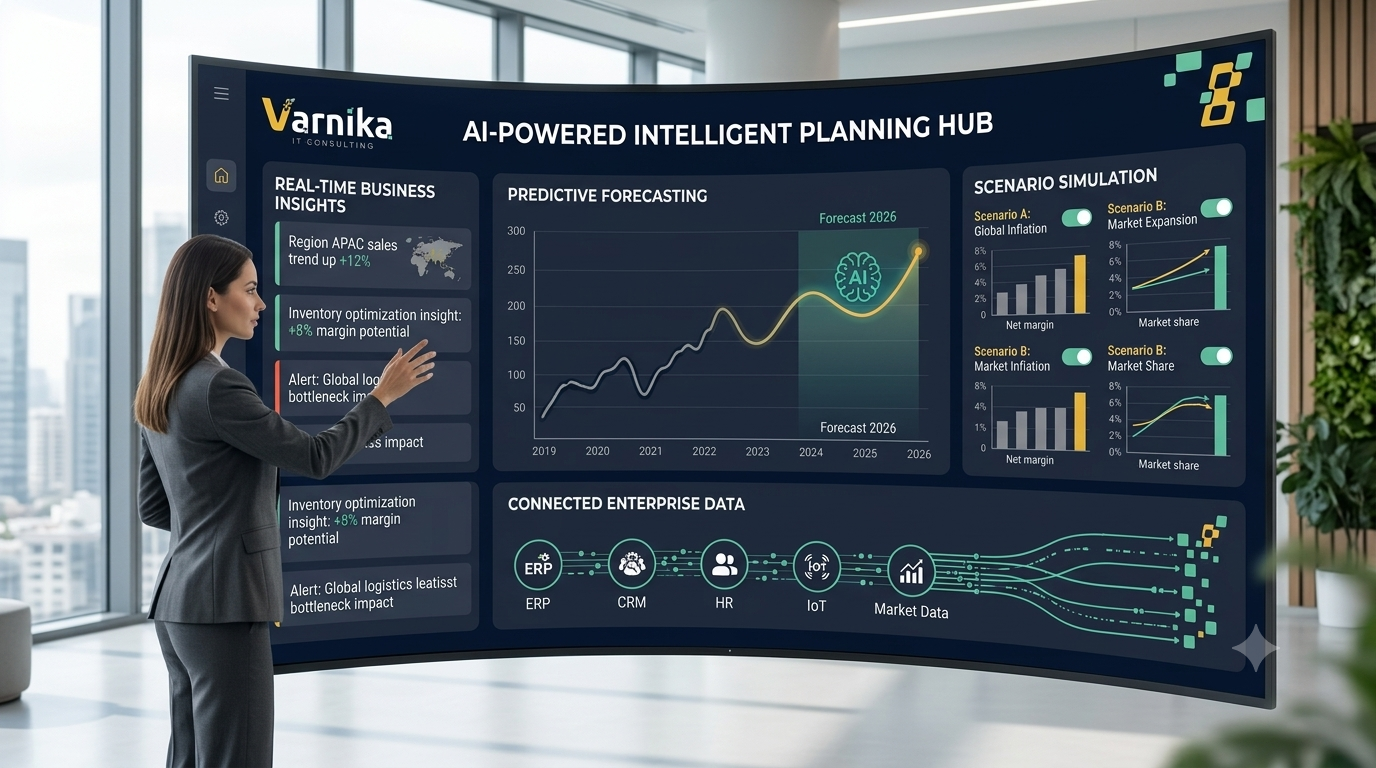
Figure 5: The future of AI-driven enterprise planning with predictive forecasting, scenario simulation, and intelligent decision support.
12. Conclusion: SAC Planning as a Business Transformation Platform
SAP Analytics Cloud Planning represents a major evolution in enterprise planning.
However, successful implementation is not achieved by simply configuring planning models.
The organizations that achieve the highest value focus on:
1. Business Process Transformation
Moving from:
- Manual budgeting
- Static forecasting
- Departmental planning
towards:
- Driver-based planning
- Connected enterprise planning
- Continuous forecasting
2. Strong Data Architecture
A successful SAC Planning landscape requires:
- Trusted master data
- Enterprise semantic models
- Clear data ownership
- Scalable integration architecture
3. Business-Led Governance
Technology provides capabilities.
Business processes create value.
CFOs, FP&A leaders, SAP architects, and IT teams must collaborate to create a sustainable planning ecosystem.
Final Perspective
The future of enterprise planning is not about producing another budget document.
It is about enabling organizations to continuously understand:
- Where they are
- Where they are going
- What risks exist
- Which decisions create the highest value
SAP Analytics Cloud Planning provides the technology foundation.
The real transformation comes from combining:
Business strategy + Data architecture + Planning discipline + Intelligent technology
That combination enables organizations to move from reactive reporting to proactive decision management.
About Varnika IT Consulting
Varnika IT Consulting helps organizations design and implement modern SAP analytics architectures across:
- SAP Analytics Cloud Planning
- SAP Datasphere
- SAP BW/4HANA
- SAPUI5 analytical applications
- Enterprise planning solutions
With deep experience across SAP analytics transformation, the focus is on creating scalable solutions aligned with real business outcomes.
Call to Action
If your organization is evaluating SAP Analytics Cloud Planning or looking to modernize its enterprise planning landscape, the first step is not selecting technology.
The first step is understanding your current planning maturity, data architecture, and business objectives.
A well-designed roadmap can help organizations avoid costly redesigns and accelerate value realization from SAP analytics investments.
Contact us for a consultation on your SAP analytics planning strategy.
Start with Part 1: ➡️ Read Part 1: Architecture, Planning Models & Integration Landscape →
About the Author: Dixit Sheta is an SAP Analytics Transformation Architect and Founder of Varnika IT Consulting, with 14+ years of experience delivering enterprise SAP analytics solutions across SAP Analytics Cloud Planning, SAP Datasphere, SAP BW/4HANA, and SAPUI5-based analytical applications.
Comments & Discussion